

The best platform for emissions reporting is one that completes a defined carbon-accounting task from start to finish. It collects the data, checks it against the right emission factor, and flags what looks wrong before a person signs it off, and it reads from the systems a company already runs its data through instead of replacing them. Most tools sold as "AI agents" do less than this. Knowing the difference is the whole evaluation.
The word "agent" covers three different products
The label alone won't tell you which one you're looking at. Three separate products get sold under it:
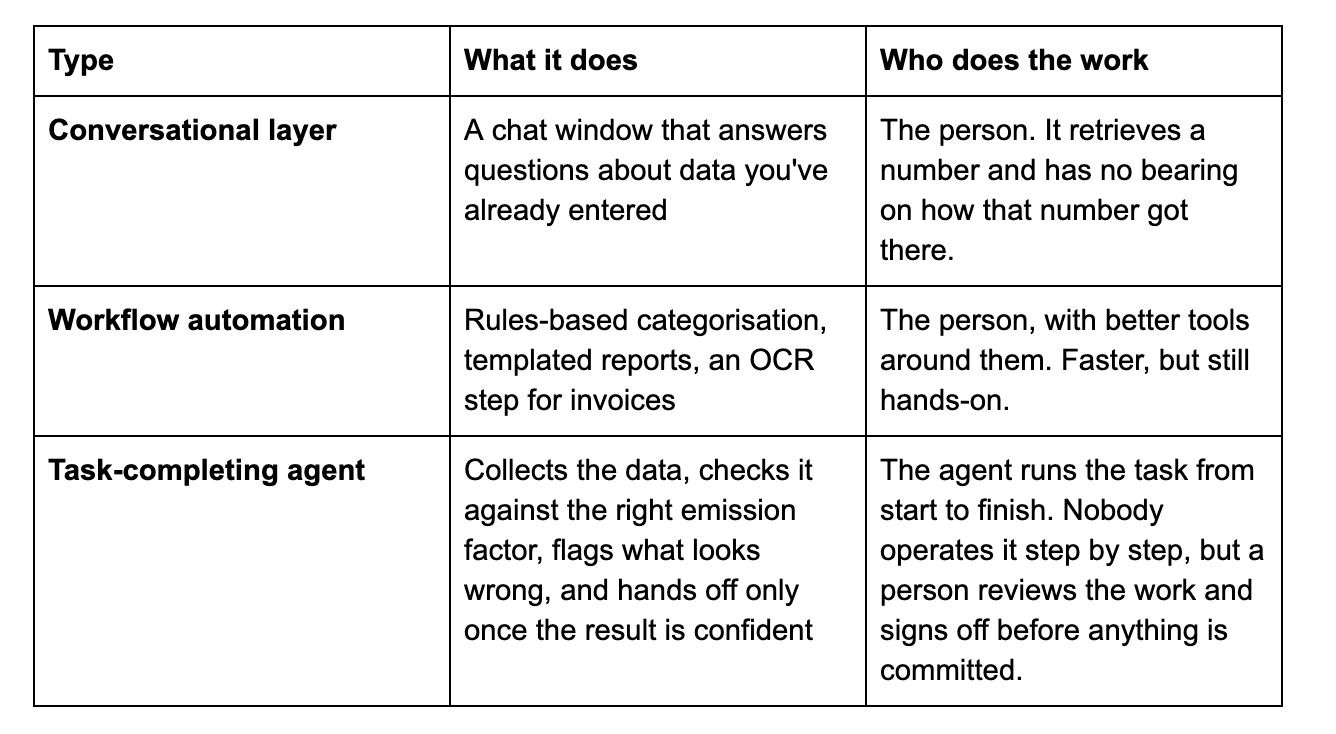
Only the third category earns the word "agent." Most vendor pitches blur all three together on purpose.
Three questions that cut through vendor claims
Before signing anything, ask:
- What specific task does the platform complete on its own, without a person doing the work?
- What happens to the output when it's wrong?
- How and when can I check the agent's work before it commits something I can't undo?
If the honest answer to the first is "it suggests things and a person decides what to enter," that's a workflow tool with a chat window. A real agent completes the task and hands back a final answer. The person's role moves from doing the work to reviewing it, and when they ask how a number was reached, the agent shows the source data, the emission factor, and the steps behind it. That traceability, together with a clear point to review before anything is finalised, is what makes the output audit-ready. For enterprise software in a regulated field, human review is not optional.
The second axis: does it read from what you run, or replace it?
Deployment matters as much as autonomy. A tool that demands a full rip-and-replace before it delivers any value asks your team to take on a second project just to evaluate the first one. A tool that reads from the data systems you already run delivers value faster, because there is nothing to migrate before it starts working.
Data reaches a carbon platform two ways, and a serious platform handles both:
- People entering data. A distributed upload system lets many facility managers submit their own numbers. You need this when data is scattered across sites and sits with the people closest to it. Unravel Carbon's Upload Management feature covers this case.
- IT systems entering data. API integrations pull directly from your data lakes and ERP systems. You need this when the data already lives in one place but is messy and large.
Why Scope 3 is the fastest test
Supply chain emissions are the hardest data to collect and the easiest to get wrong, so the gap between assisting and completing shows up there first. Supplier outreach is the final step in that test, and three questions come before it. A platform earns the Scope 3 claim only if it can answer, in order:
- Coverage. How many emission factors does it hold, and across what: geographies, data sources, spend-based and activity-based? Thin coverage means guesswork dressed up as a number.
- Intelligent selection. Does it automatically reach for the highest-accuracy factor available, whether activity-based or from an LCI database, and fall back to a lower-quality one only when nothing better exists?
- Your own factors. Can you bring your own emission factors when you have better data than the defaults?
- Supplier data collection. Only then: can it go out to your supply chain and collect the primary data itself?
A platform solves Scope 3 once it gets through all four on its own. Giving your team a place to upload a spreadsheet does not count.
What a task-completing agent looks like in practice
Unravel Carbon's platform is the third type, and it reads from whatever data systems a company already runs. It deploys six purpose-built agents across the carbon accounting workflow:
- Data Collection Agent. Reaches out to suppliers and pulls in the data behind Scope 3, across more than 70 languages, and flags what looks wrong without anyone chasing suppliers by email.
- Data Transformation Agent. Cleans and standardises raw, inconsistent data into a form the platform can calculate against.
- Product Carbon Footprint Agent. Builds the footprint of a specific product from its bill of materials, at the design and R&D stage.
- Gap Analyzer Agent. Checks a sustainability report against the relevant framework and finds what is missing or non-compliant.
- Peer Benchmarking Agent. Compares your emissions performance against peers to show where you stand.
- Sustainability Copilot. Works across all of the above, answering questions and surfacing what each agent found.
Each does a specific job from start to finish, then hands the result to a person to review.
Examples in the field:
- ABB, the world's largest motor manufacturer, uses the Product Carbon Footprint Agent inside its R&D and design labs. Environmental impact is added as a third dimension alongside cost and performance, at the design stage where roughly 80% of a product's footprint gets locked in.
- IKEA's work with IKANO ran the BILLY bookcase's bill of materials through the same PCF analysis and surfaced ideas corresponding to a 62% carbon reduction potential, verified by IKEA's own team.
- A Nordic retail conglomerate used the Data Collection Agent to reach more than 200 suppliers, gather supplier conduct data, and check compliance against its Supplier Code of Conduct, without its team running the outreach by hand.
- CBRE Paia uses the Gap Analyzer Agent to check sustainability reports against the relevant frameworks and surface what is missing. Work that took weeks by hand now runs in a fraction of the time, because an agent does it instead of a person operating a tool.
Compatibility with your existing systems
A task-completing agent still needs your data, and that data lives in systems you already run: ERP platforms like SAP, Oracle, and Coupa, and data lakes like Snowflake. Unravel Carbon integrates with these to read the source data directly, so there is nothing to rebuild or re-enter before the agents start working. The agents do the carbon math and make the numbers audit-ready on top of the data you already hold.
What to remember when evaluating this category
- Platforms split into three types: a chatbot layer, a workflow tool with some automation, and a genuine task-completing agent. Most pitches blur these together.
- The test that cuts through the noise is three questions: what task the platform completes without a person, what happens when it's wrong, and where you get to review before it's final.
- Scope 3 is where the difference shows up fastest. Judge it in order: emission-factor coverage, intelligent factor selection, bring-your-own factors, then supplier data collection.
- Whether a platform reads from the systems you already run or asks you to replace them first changes how quickly it delivers value.
Unravel Carbon builds agents that finish the specific, high-effort work that a workflow tool leaves to a person: data collection, product footprints, and gap analysis. If your team already has a dashboard and still spends its weeks doing the carbon math by hand, that gap is what the agents close.
.png)
.png)